A Complete Guide to Industrial Conveyor Rollers: Selection & Trusted Supplier for Buyers
For buyers in industrial, logistics and automation industries, choosing the right conveyor rollers directly affects procurement costs, operational efficiency and maintenance workload. Conveyor rollers vary greatly in different scenarios, and selecting the most suitable one while finding a reliable supplier is the key to saving costs and worry. Today, we will simplify the popular science of mainstream conveyor rollers, focus on procurement needs, and recommend a trusted partner — GCS.
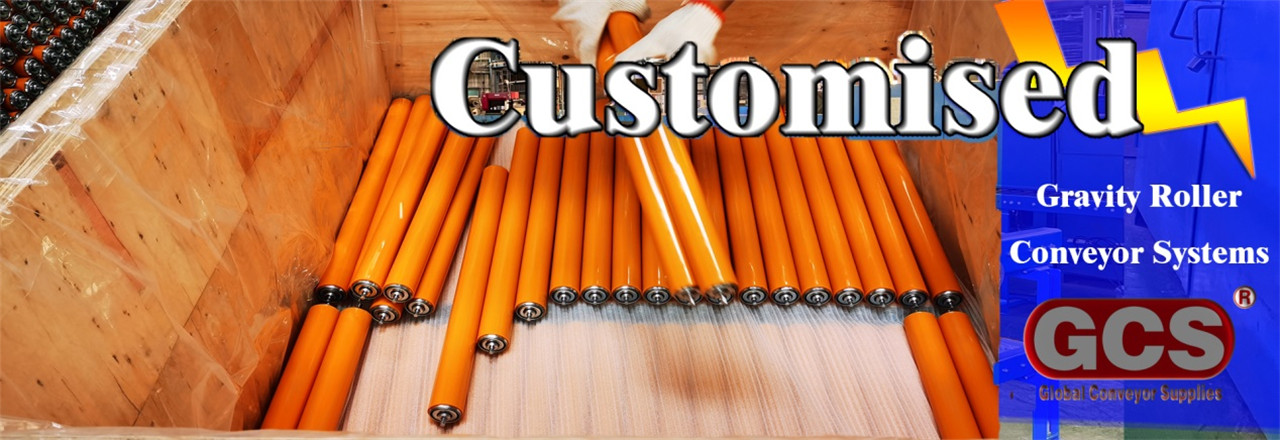
Proper Conveyor Roller Selection = Lower Costs & Higher Efficiency
Many businesses fall into the trap of focusing only on price rather than suitability when selecting conveyor rollers. An ill-fitted roller not only causes frequent failures and increased maintenance costs, but also slows down entire production lines. For example, using light plastic rollers in heavy-duty conditions leads to easy breakage; using ordinary metal rollers for precision goods transportation scratches products and generates noise. Only by matching rollers precisely to working conditions can they truly boost, not hinder, production.

Core Strengths of GCS Conveyor Rollers
1. Full-range customization capability: Flexible customization of roller size, specification, material performance and structural design is available to perfectly adapt to the operational requirements of different application scenarios and working conditions.
2. Premium manufacturing & strict quality control: Adopt high-grade raw materials, precision machining processes and ISO-certified standardized production systems; each unit undergoes rigorous multi-dimensional performance testing to ensure stable structure, reliable operation, and excellent wear, impact and corrosion resistance for complex working conditions.
3. Efficient delivery service: Fast lead times for both standard and custom-made rollers, with quick sample delivery available to meet pre-bulk procurement testing needs.
4. Competitive pricing & bulk benefits: Factory-direct pricing for high cost performance, with exclusive preferential policies and greater discounts for bulk procurement.
5. Professional after-sales support: Provide one-stop after-sales technical support to effectively solve various application problems of rollers in long-term use.
4 Simple Selection Principles for Buyers
◆Look at load: Metal/steel for heavy loads; nylon/plastic/gravity for light loads.
◆Look at working conditions: Nylon/plastic for corrosion; PU for silent protection; grooved for anti-slip.
◆Look at versatility: Adjustable rollers for multi-spec materials; spring-loaded for fragile goods.
◆Look at supplier: Prioritize factory-direct suppliers with customization capability, fast delivery and after-sales service (like GCS).
Why Choose GCS?
For buyers, choosing a trusted supplier is as important as choosing the right product. GCS has been focusing on the needs of global buyers for 30+ years, with obvious advantages:
✅ Factory-direct supply: No middlemen, bulk price advantage, lowers procurement costs.
✅Full customization: Size, material, hardness, and surface design are customizable to perfectly match working conditions.
✅Fast delivery: 5-7 days for standard orders, with priority given to urgent orders.
✅Quality guarantee: ISO certification, strict QC system, verified by 500+ global projects, reducing replacement and maintenance costs.
✅One-stop service: Pre-sales consultation, in-sales follow-up, and after-sales maintenance solve all procurement concerns.
For industrial buyers, the most cost-effective choice is to select the right conveyor rollers and cooperate with a reliable supplier. GCS, with 30+ years of ingenuity, provides high-quality, cost-effective, and customizable conveyor roller solutions, simplifying procurement processes.
Partner with GCS for Reliable Conveyor Solutions
Conveyor rollers may seem like simple components, but their performance directly affects your entire production efficiency. With GCS, you gain more than just a roller — you gain a trusted partner dedicated to providing long-term support, precision products, and professional guidance.
Whether you need standard conveyor rollers or customized solutions for demanding applications, GCS has the expertise, capacity, and commitment to help your business move forward.
Frequently asked questions about conveyors roller
What Is a Conveyor Roller?
A conveyor roller is a line in which multiple rollers are installed for the purpose of transporting goods in a factory, etc., and the rollers rotate to transport the goods. They are also called roller conveyors.
They are available for light to heavy loads and can be selected according to the weight of the cargo to be transported.
In most cases, a conveyor roller is a high performance conveyor that is required to be impact and chemical resistant, as well as being able to transport items smoothly and quietly.
Inclining the conveyor allows the conveyed material to run on its own without external drive of the rollers.
What to Consider When Choosing a Roller?
Your rollers must fit your system exactly for optimal performance. Some different aspects of each roller include:
Size: Your products and conveyor system size correlate to the roller size. The standard diameter is between 7/8″ to 2-1/2″, and we have custom options available.
Material: We have several options for roller materials, including galvanized steel, raw steel, stainless steel and PVC. We can also add urethane sleeving and lagging.
Bearing: Many bearing options are available, including ABEC precision bearings, Semi-precision bearings and Non-precision bearings, among other options.
Strength: Each of our rollers has a designated load weight specified in the product description. Rolcon provides both lightweight and heavy-duty rollers to match your load sizes.
Uses of Conveyor Rollers
Conveyor rollers are used as conveyor lines to move loads from one location to another, for example, in a factory.
The conveyor rollers are suitable for conveying objects with relatively flat bottoms, as there may be gaps between the rollers.
Specific materials conveyed include food, newspapers, magazines, small packages, and many others.
The roller does not require power and can be pushed by hand or propelled by itself on an incline.
Conveyor rollers are often used in situations where cost reduction is desired.
Principle of Conveyor Rollers
A conveyor is defined as a machine that continuously transports a load. There are eight major types, of which belt conveyors and roller conveyors are the most representative.
The difference between belt conveyors and roller conveyors is the shape (material) of the line conveying the cargo.
In the former, a single belt rotates and is transported on it, while in the case of a roller conveyor, multiple rollers rotate.
The type of rollers is selected according to the weight of the cargo to be conveyed. For light loads, the roller dimensions range from 20 mm to 40 mm, and for heavy loads up to about 80 mm to 90 mm.
Comparing them in terms of conveying force, belt conveyors are more efficient because the belt makes surface contact with the material to be conveyed, and the force is greater.
Roller conveyors, on the other hand, have a smaller contact area with the rollers, resulting in a smaller conveying force.
This makes it possible to convey by hand or at an incline, and it has the advantage of not requiring a large power supply unit, etc., and can be introduced at a low cost.
How do I know what roller diameter to choose for gravity conveyors?
A typical 1 3/8” diameter roller has a capacity of 120 lbs. per roller. A 1.9” diameter roller will have an approximate capacity of 250 lbs. per roller. With rollers set on 3” roller centers, there are 4 rollers per foot, so the 1 3/8” rollers would typically carry 480 lbs. per foot. The 1.9” roller is a heavy duty roller that handles approximately 1,040 lbs. per foot. The capacity rating can also vary based on how the section is supported.
Conveyor Rollers Replacement That’s Customized to Your Requirements
In addition to a large number of standard sized rollers, we are also able to craft individual roller solutions for niche applications. If you have a challenging system that needs rollers that are made to your particular dimensions or that need to be able to cope with a particularly tough environment, we can normally come up with a suitable answer. Our company will always work with customers to find an option that not only delivers the required objectives, but which is also cost-effective and able to be implemented with minimal disruption. We provide rollers to a wide range of industries, including companies involved in ship building, chemical processing, food & beverage production, transport of hazardous or corrosive substances and many more.
Talk to an engineer
Write your message here and send it to us
Share our interesting knowledge and stories on social media